
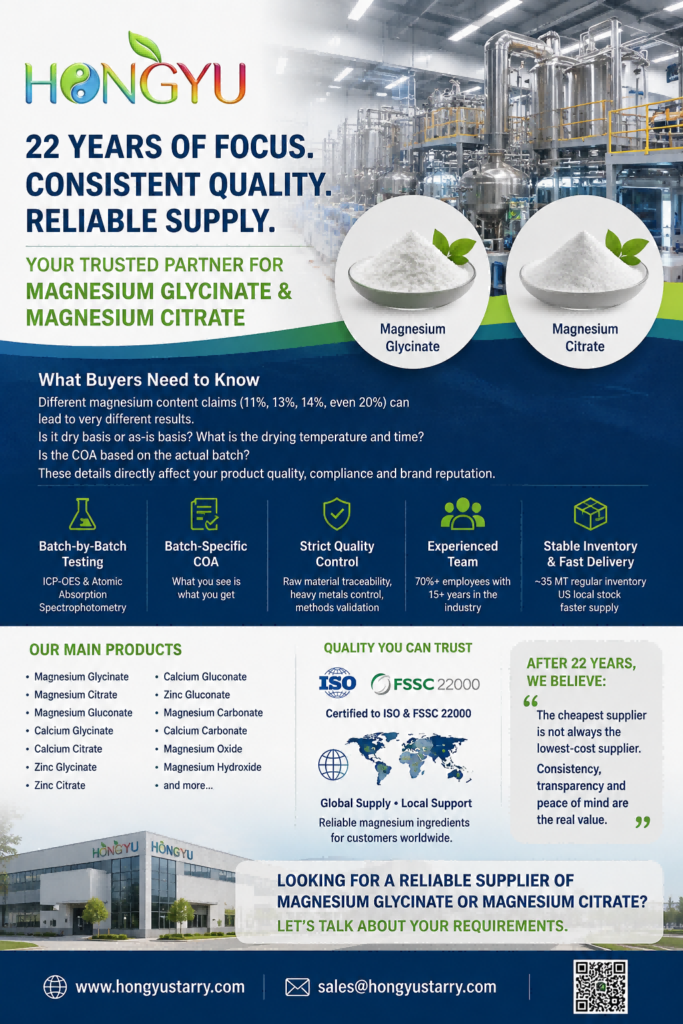
22 Years of Focus. Consistent Quality. Reliable Supply.
Over the past 22 years, as leading magnesium glycinate suppliers, we have witnessed the evolution of the magnesium ingredients industry firsthand.
We started with Magnesium Carbonate and Magnesium Oxide. As the nutritional supplement market developed, Magnesium Citrate became increasingly important. Today, Magnesium Glycinate has become one of the most widely discussed and increasingly demanded magnesium ingredients in the global dietary supplement industry.
For us, this evolution feels almost like watching a child grow from childhood into adulthood.
But the transformation is not only about magnesium products.
It also reflects the gradual improvement in consumers’ understanding of nutritional supplementation, the increasing sophistication of supplement formulations, and the higher expectations placed on raw material suppliers.
At the same time, after more than two decades in this industry, we have also seen some challenges that buyers should not overlook.
When a New Ingredient Becomes Popular, Everyone Starts Making It
There is a common phenomenon in the raw material industry.
Whenever a new ingredient becomes commercially attractive, a large number of manufacturers quickly enter the market.
Competition itself is not a problem.
In fact, healthy competition can encourage technological improvement and provide buyers with more choices.
The challenge is that the number of suppliers does not necessarily mean the number of reliable suppliers has increased at the same rate.
Products may carry exactly the same name while differing significantly in:
- Raw material sources
- Manufacturing processes
- Active ingredient content
- Testing methods
- Batch-to-batch consistency
- Heavy metal control
- Traceability
- Documentation
- Inventory availability
- Delivery reliability
Almost every supplier can say:
“Our product is the best.”
For professional buyers, however, the more important question is:
What exactly are you buying?
And perhaps an even more important question:
Can the supplier consistently reproduce the same quality in every batch?
Magnesium Glycinate: The Number on the COA Is Not the Whole Story
Magnesium Glycinate is a good example of why buyers need to look beyond a single specification.
Depending on the supplier and product composition, buyers may encounter magnesium content claims such as 11%, 13%, 14%, or even around 20% in certain products where magnesium oxide is incorporated.
Seeing different numbers does not automatically mean that one product is good and another is bad.
The critical issue is understanding how the number was obtained and what the number actually represents.
For example:
Is the magnesium content reported on a dry basis or as-is basis?
If the result is reported on a dry basis:
- What was the drying temperature?
- How long was the sample dried?
- What moisture level was used as the endpoint?
- What analytical method was applied?
- Are the testing conditions comparable between suppliers?
These details are extremely important when comparing specifications from different manufacturers.
A specification such as “13% Magnesium” may look straightforward on paper.
But without understanding the testing basis and methodology, two products carrying similar numbers may not necessarily be directly comparable.
This is why professional raw material purchasing requires more than simply comparing numbers on different quotations.
Why an Inaccurate Raw Material Specification Can Become a Brand Problem
The consequences of raw material quality do not necessarily stop at the purchasing department.
A raw material specification can eventually influence:
Finished-product formulation → nutritional labeling → regulatory compliance → product consistency → customer confidence → brand reputation
We have personally witnessed situations where customers experienced serious problems after purchasing incorrectly specified raw materials.
The amount saved when purchasing the cheaper material can appear attractive at the beginning.
But compared with the potential cost of:
- Product rework
- Production delays
- Labeling problems
- Regulatory issues
- Customer complaints
- Product recalls
- Quality disputes
- Damage to brand reputation
the original price difference may become almost insignificant.
This is why raw material purchasing should never be based on price alone.
A COA Should Represent the Actual Batch
Another important issue is the Certificate of Analysis (COA).
Many suppliers state that every batch is strictly tested.
But buyers should ask a simple question:
Does the COA actually represent the batch being shipped?
A professional COA should correspond to the actual production batch.
It should not simply reproduce the results of a previous batch.
It should not be based on an expected result.
And it should not be prepared simply because a shipment is urgently waiting to leave the warehouse.
A COA should tell you what you are actually receiving.
For buyers, batch-specific documentation is an important part of supplier qualification.
A reliable supplier should be able to provide appropriate information regarding:
- Batch number
- Test results
- Testing methods
- Manufacturing date
- Raw material traceability
- Relevant quality parameters
- Heavy metal control
- Product specifications
Transparency in documentation is not an optional extra.
It is part of responsible supply-chain management.
Certification Is Important — But Certification Alone Is Not Enough
Quality certifications such as ISO and FSSC 22000 are important components of a supplier’s quality management system.
However, certification should not be viewed as a substitute for actual quality control.
A buyer should also look deeper into the supplier’s daily operations.
For example:
Are raw materials traceable?
Is every production batch actually tested?
Are analytical methods clearly defined?
Are laboratory instruments properly maintained and calibrated?
Are heavy metals appropriately controlled?
Can the supplier provide genuine batch-specific documentation?
Does the factory have qualified personnel with sufficient industry experience?
Are production procedures consistently followed?
A certificate demonstrates that a management system meets defined requirements.
But consistent manufacturing, reliable laboratory testing and effective traceability demonstrate whether that system works in practice.
Ultimately, Quality Comes Down to People
Advanced equipment is important.
Quality systems are important.
Testing methods are important.
But behind all of these systems are people.
The production operator needs to follow the manufacturing process correctly.
The laboratory technician needs to test each batch carefully.
The quality team needs to review results objectively.
The purchasing team needs to maintain raw material traceability.
And the sales team needs to communicate accurately with customers.
For a raw material supplier, honesty in communication is just as important as technical capability.
A sales representative should be able to accurately answer questions such as:
- What is the actual product specification?
- What is the realistic lead time?
- How much inventory is actually available?
- Is the material currently in production or already in stock?
- What are the differences between product grades?
- Can the requested documentation be provided?
What a supplier tells you should match what the factory can actually deliver.
Supply Reliability Is Also Part of Product Quality
For manufacturers and supplement brands, quality is not the only concern.
Supply reliability matters too.
Imagine that a supplier offers a competitive price but cannot maintain the agreed delivery schedule.
The resulting production interruption may cost far more than the original raw material price difference.
This is why buyers should also consider:
Actual inventory
Production capacity
Lead time
Batch consistency
Documentation
Communication
Emergency response capability
A supplier with a slightly higher quotation but reliable inventory and consistent delivery may ultimately be a much lower-risk and lower-cost partner.
The cheapest quotation is not always the lowest-cost solution.
Why Yantai Hongyu Starry Biotech Takes a Different Approach
At Yantai Hongyu Starry Biotech Co., Ltd., we have been working in the mineral salt and nutritional ingredient industry for more than two decades.
Our experience covers the evolution of the market from traditional mineral ingredients such as Magnesium Carbonate and Magnesium Oxide, to more sophisticated forms such as Magnesium Citrate and Magnesium Glycinate.
More than 70% of our employees in production, laboratory testing and sales have more than 15 years of industry experience.
We believe that this experience provides an important foundation for understanding not only the products themselves, but also the practical requirements of international customers.
Our approach focuses on several fundamental principles.
1. Batch-by-Batch Testing
We test our materials batch by batch in our inorganic analysis laboratory.
Our laboratory is equipped with:
ICP-OES
and
Atomic Absorption Spectrophotometry
These analytical capabilities support the testing and control of mineral elements and help us maintain consistent product quality.
2. Batch-Specific COAs
We issue batch-specific Certificates of Analysis for supplied materials.
Our philosophy is simple:
What you see in the documentation should correspond to what you receive.
For professional buyers, reliable documentation is an essential part of supplier qualification and long-term cooperation.
3. Raw Material Traceability and Quality Control
We pay close attention to raw material traceability, manufacturing control and heavy metal management.
Quality should not be controlled only at the end of the production process.
It should be managed throughout the supply chain — from raw materials to manufacturing, laboratory testing and final shipment.
4. Experienced People
More than 70% of our production, laboratory and sales personnel have more than 15 years of industry experience.
We believe long-term industry experience matters because mineral ingredients require more than theoretical knowledge.
It requires practical understanding of:
production processes + analytical testing + quality management + customer requirements + supply-chain coordination
5. Stable Inventory and Reliable Delivery
For our regular mineral ingredients, we typically maintain around 35 MT of stable inventory, helping us provide more reliable lead times and reduce supply interruptions.
For customers in the United States, we also maintain US inventory, allowing us to provide a more responsive supply option when local availability and shorter delivery times are important.
Our Mineral Ingredient Portfolio
Our regular product portfolio includes a broad range of magnesium, calcium and zinc ingredients.
Magnesium Ingredients
- Magnesium Glycinate
- Magnesium Citrate
- Magnesium Gluconate
- Magnesium Malate
- Magnesium Carbonate
- Magnesium Oxide
- Magnesium Hydroxide
- Magnesium Taurate
- Magnesium Ascorbate
- Magnesium Glycerophosphate
Calcium Ingredients
- Calcium Glycinate
- Calcium Citrate
- Calcium Citrate Malate
- Calcium Carbonate
- Calcium Glycerophosphate
- Calcium Ascorbate
- Calcium Gluconate
Zinc Ingredients
- Zinc Glycinate
- Zinc Gluconate
- Zinc Picolinate
- Zinc Citrate
- Zinc Malate
- Zinc Oxide
These ingredients serve a wide range of applications in dietary supplements, nutritional products, functional foods and other health-related formulations, subject to applicable regulatory requirements.
Choosing a Magnesium Supplier: What Should Buyers Really Ask?
Before placing an order, we recommend that buyers look beyond the quotation.
Ask your potential supplier:
1. What exactly is the product specification?
Do not simply compare the product name.
Understand the actual composition and analytical basis.
2. How is the active mineral content tested?
Ask about the analytical method and testing basis.
3. Is the COA batch-specific?
Make sure the document corresponds to the actual batch being supplied.
4. Can the raw materials be traced?
Traceability is an important part of supply-chain risk management.
5. How are heavy metals controlled?
This is particularly important for mineral ingredients used in nutritional products.
6. What is the actual inventory?
Do not confuse “we can supply” with “we have the material available.”
7. What is the realistic lead time?
A reliable supplier should provide a realistic delivery commitment rather than an attractive but unrealistic promise.
After 22 Years, Our Philosophy Is Simple
After more than two decades in the mineral ingredients industry, we believe that the relationship between a supplier and a buyer should go beyond a purchase order.
A reliable supplier should consistently provide:
The right product.
The right specification.
The right documentation.
The right quantity.
The right quality.
And the right delivery time.
Because ultimately:
The cheapest supplier is not always the lowest-cost supplier.
Consistency, transparency, traceability and reliable supply can be far more valuable than a slightly lower quotation.
At Yantai Hongyu Starry Biotech Co., Ltd., our goal is not simply to supply mineral ingredients.
Our goal is to become a reliable part of your supply chain.
Looking for a Reliable Magnesium, Calcium or Zinc Ingredient Supplier?
If your company is currently sourcing:
Magnesium Glycinate
Magnesium Citrate
Magnesium Gluconate
Magnesium Malate
Magnesium Glycerophosphate
or other magnesium, calcium and zinc ingredients
we welcome the opportunity to discuss your specifications, quality requirements and supply plans.
Yantai Hongyu Starry Biotech Co., Ltd.
🌐 www.hongyustarry.com
📧 sales@hongyustarry.com
22 Years of Focus. Consistent Quality. Reliable Supply.