
A Technical White Paper on Molecular Structure, Dehydration Kinetics, and Quality Control Analysis
In the nutraceutical and pharmaceutical ingredient industries, Magnesium Bisglycinate (also known as Magnesium Glycinate) has become a premier choice in the mineral supplement market due to its high bioavailability and exceptional gastrointestinal tolerance. However, during routine Quality Control (QC) and Incoming Quality Control (IQC) analytical testing, laboratories frequently encounter severe data discrepancies:
“Why does the same batch of Magnesium Glycinate yield Loss on Drying (LOD) results that differ by more than a factor of ten under different drying temperatures?”
“Why do some samples that appear extremely dry on the surface exhibit actual elemental magnesium levels that plummet far below the theoretical minimum?”
To unravel the essence behind these contradictory figures, one must dissect the data through the lenses of molecular chemical structure, physical dehydration kinetics, and modern instrumental analysis. A fundamental industry reality must be clarified: Relying strictly on the absolute value of “Loss on Drying” to simplistically judge the quality of Magnesium Glycinate is not only technically inaccurate but highly susceptible to the misinterpretation of paper metrics.
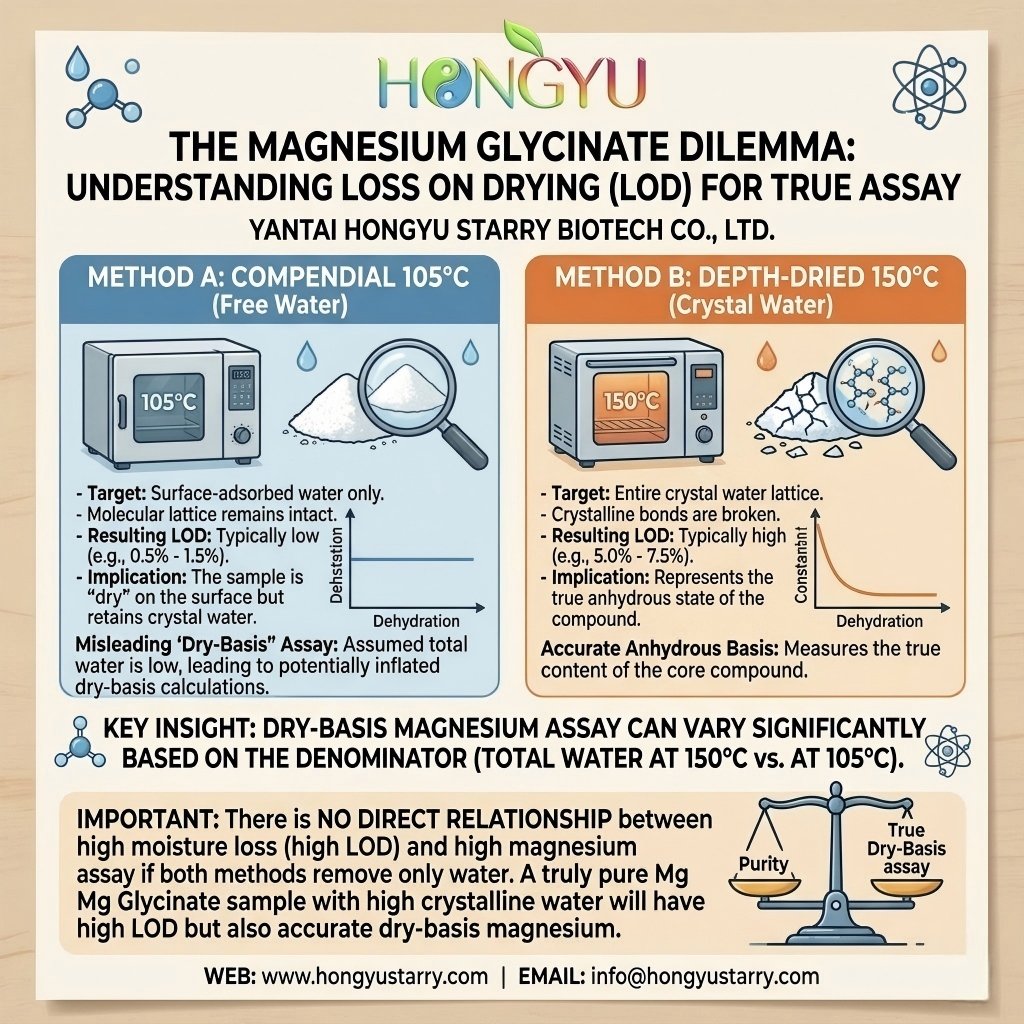
I. The Physicochemical Divide: The Fundamental Difference Between 105°C and 150°C
When discussing “Loss on Drying (LOD)” on a Specification sheet or a Certificate of Analysis (COA), specifying the exact testing temperature and baking duration is paramount; without these parameters, any percentage value is scientifically meaningless.
In current analytical testing frameworks, two distinctly different temperature protocols exist, each corresponding to entirely separate physical and chemical dehydration processes:
1. The Conventional Atmospheric Method: 105°C
Under standard compendial testing standards (such as pharmacopeial general chapters), the regulatory temperature for testing the Loss on Drying of amino acid chelated minerals is typically set at 105°C.
- Physical Essence: 105°C sits just above the boiling point of water. At atmospheric pressure, the thermal kinetic energy provided at this temperature can only drive off the physically adsorbed free water (surface moisture) on the powder.
- Data Performance: If a batch of Magnesium Glycinate raw material possesses excellent post-production packaging integrity and moisture-proof sealing, its LOD at 105°C will be exceptionally low, typically hovering between 0.5% and 1.0%. This merely proves that the powder surface is dry; it fails entirely to reflect the actual bound moisture trapped inside the molecular crystal lattice.
2. The Deep Dehydration Method: 150°C for 4 Hours
In many internal enterprise standards or specific industrial manufacturing specifications for high-purity chelated materials, the analytical testing condition is aggressively elevated to 150°C.
- Physical Essence: 150°C represents intensive physical forced dehydration. At this elevated temperature, the oven provides sufficient kinetic energy to forcibly break the crystal lattice, completely expelling the chemically bound “crystalline water” that is deeply integrated within the Magnesium Glycinate molecules.
- Data Performance: After continuous baking at 150°C for 4 hours, monohydrate or dihydrate crystal particles that initially appeared surface-dry will routinely release a high percentage of crystalline water, typically resulting in an LOD ranging from 4.0% to 7.0% or higher.
II. Debunking the Mathematical Myth: Why High Loss on Drying Can Indicate Superior Chemical Purity
Inexperienced quality control personnel frequently fall into a habitual trap: assuming that a sample with an LOD as high as 5.8% is “too wet and lacks purity,” while blindly praising another sample with an LOD of only 1.14% as “dry and pure.”
In crystal chemistry, this logic is completely inverted. Let us deconstruct this utilizing a mathematical closed-loop analysis of a pure Magnesium Glycinate Monohydrate
Mg(C2H4NO2)2
⋅H2O matrix:
Suppose a high-standard production line yields a batch of pure Magnesium Glycinate Monohydrate, whose true dry-basis magnesium content is 14.0% upon full dehydration (approaching the theoretical anhydrous limit of 14.1%). Because the monohydrate molecule contains bound crystalline water within its structure, the actual total magnesium content of the raw material prior to baking (as-is / wet basis) is approximately 13.19%.
1. Testing via the 150°C Deep Dehydration Method:
The 150°C high-temperature protocol forcibly expels the entire 5.8% of total water (including crystalline water) from the lattice. The laboratory applies the standard dry-basis calculation formula:
Dry-Basis Magnesium Content = [True Total Magnesium (Wet Basis) 13.19%] / [1 – 0.058 (150°C LOD)] = 14.0%
Conclusion: The calculated dry-basis magnesium perfectly reaches the theoretical maximum of the pure anhydrous substance. This mathematically proves that the chemical backbone of the raw material is highly pure, with virtually no non-magnesium organic impurities generated during synthesis.
2. Testing via the 105°C Conventional Method:
If the exact same batch of high-purity material is tested at 105°C, the crystalline water remains securely locked within the crystal lattice. The instrument only measures the 1.14% surface physically adsorbed moisture. Applying the identical dry-basis formula:
Apparent 105°C Dry-Basis Magnesium = [True Total Magnesium (Wet Basis) 13.19%] / [1 – 0.0114 (105°C LOD)] = 13.34%
Conclusion: Because the denominator fails to exclude the bound crystalline water at 105°C, the calculated dry-basis value artificially drops to 13.34%.
The Ultimate Industrial Blunder Zone:
If during actual laboratory testing, a sample exhibits an LOD of only 1.14% at 105°C (indicating a very dry surface) but yields an actual dry-basis elemental magnesium content of only 11.5%, a major chemical flaw is exposed: For a sample that is so physically dry, a dry-basis magnesium level of 11.5% fails to even reach the fundamental baseline requirement of Magnesium Glycinate Monohydrate (12.8%). This serves as irrefutable proof that the material contains an abundance of unreacted organic impurities (such as free glycine or peptide by-products) that contain no magnesium, thereby severely diluting the active compound. Therefore: Samples with low Loss on Drying do not guarantee high purity, whereas samples with high Loss on Drying can exhibit exceptional true dry-basis chemical purity once correctly calculated.
III. Characterizing Hydrates: Theoretical Quantitation of Monohydrate vs. Dihydrate
Assuming full chemical reaction during processing (with no intentional adulteration with exogenous magnesium salts), pure chelated Magnesium Glycinate primarily exists as either a monohydrate or a dihydrate. While indistinguishable by visual inspection, their molecular identity can be precisely deduced via 150°C deep baking combined with accurate moisture or elemental titration:
• Magnesium Glycinate Monohydrate Mg(C2H4NO2)2·H2O
Molecular Weight: ~190.44; Theoretical Crystalline Water Ratio: ~9.46%. Physicochemical Performance: Highly stable at 105°C (surface adsorbed moisture is typically < 1.0%), releasing its crystalline water only when subjected to 150°C. Due to industrial-scale lattice vacancies, actual measured 150°C LOD typically ranges from 4.5% to 6.0%. Its corresponding unbaked, original total magnesium content (wet basis) falls between 12.6% and 13.2%.
• Magnesium Glycinate Dihydrate Mg(C2H4NO2)2·2H2O
Molecular Weight: ~208.45; Theoretical Crystalline Water Ratio: ~17.2%. Physicochemical Performance: Because it carries two water molecules, its lattice configuration is relatively unstable; even at 105°C, an irreversible release and evaporation of crystalline water will occur. Its original, unbaked theoretical total magnesium content sits at only 11.2% to 11.6%.
IV. Quality Assurance Warning: The “Chemical Blind Spot” of Total Magnesium Assay
Beyond mastering the mathematical parameters of temperature and moisture, quality audit teams must remain acutely aware of a shared blind spot among mainstream elemental assay methods. Whether a laboratory employs the industry gold-standard Inductively Coupled Plasma Optical Emission Spectrometry (ICP-OES), Atomic Absorption Spectrophotometry (AAS), or traditional EDTA Complexometric Titration, all of these methods require the sample to undergo complete acid digestion during sample preparation.
The Core Vulnerability: The digestion process entirely destroys and obliterates the organic amino acid backbone, leaving only free magnesium ions in the analyte solution. Consequently, the instruments only detect the presence of “elemental magnesium (Mg)”; they cannot differentiate whether that magnesium originated from premium, highly bioavailable “fully reacted chelated Magnesium Glycinate” or from cheap, inorganic “Magnesium Oxide (MgO)”.
The “Buffered” Adulteration Trap: Because Magnesium Oxide (MgO) possesses an extraordinarily high elemental magnesium ratio (~60%) and is exceptionally heat-resistant, sub-standard manufacturers often physically blend 20% to 40% MgO into Magnesium Glycinate to create a “buffered” compound. When tested solely via ICP-OES for total magnesium, the assay value will deceptively spike to 18%–22%. While visually impressive on a report, this material completely loses the gentle gastrointestinal profile and high absorption properties of a true chelate.
V. Establishing a Scientifically Sound IQC Protocol for Magnesium Glycinate
In conclusion, to avoid being misled by an isolated LOD or total magnesium assay percentage, a scientific quality control program must implement a cross-validating “multi-metric” testing matrix:
1. Mandate Dual-Temperature Moisture Thresholds: Explicitly require an LOD (105°C, 2H) of ≤ 1.0% to lock down surface free moisture, ensuring physical powder flowability and anti-caking properties in production; simultaneously require an LOD (150°C, 4H) of ≤ 7.0% to guarantee full liberation of crystalline water for a mathematically accurate dry-basis calculation denominator.
2. Enforce a Strict Dry-Basis Total Magnesium Window: Under the condition of 150°C aggressive forced dehydration, the dry-basis magnesium content must be tightly locked between 13.6%
and 14.1%. A lower value (<12%) indicates unreacted organic impurities; an inflated value (>15%) confirms physical adulteration with inorganic magnesium salts.
3. Integrate Structural Confirmation Testing: Supplement elemental assays with FTIR (Fourier Transform Infrared Spectroscopy) fingerprint scans to verify the specific coordinate covalent bonding between the glycinate ligands and the magnesium core. Alternatively, mandate a Free Magnesium (Free Mg²■) ratio of ≤ 0.1% to entirely eliminate the possibility of physical blending with Magnesium Oxide.
Technical Discussion & Clearances
Have technical questions regarding Magnesium Glycinate LOD (105°C vs 150°C) or specification adjustments? Leave your inquiry below. Our compliance desk at Yantai Hongyu Starry Biotech Co., Ltd. will respond within 24 hours.