
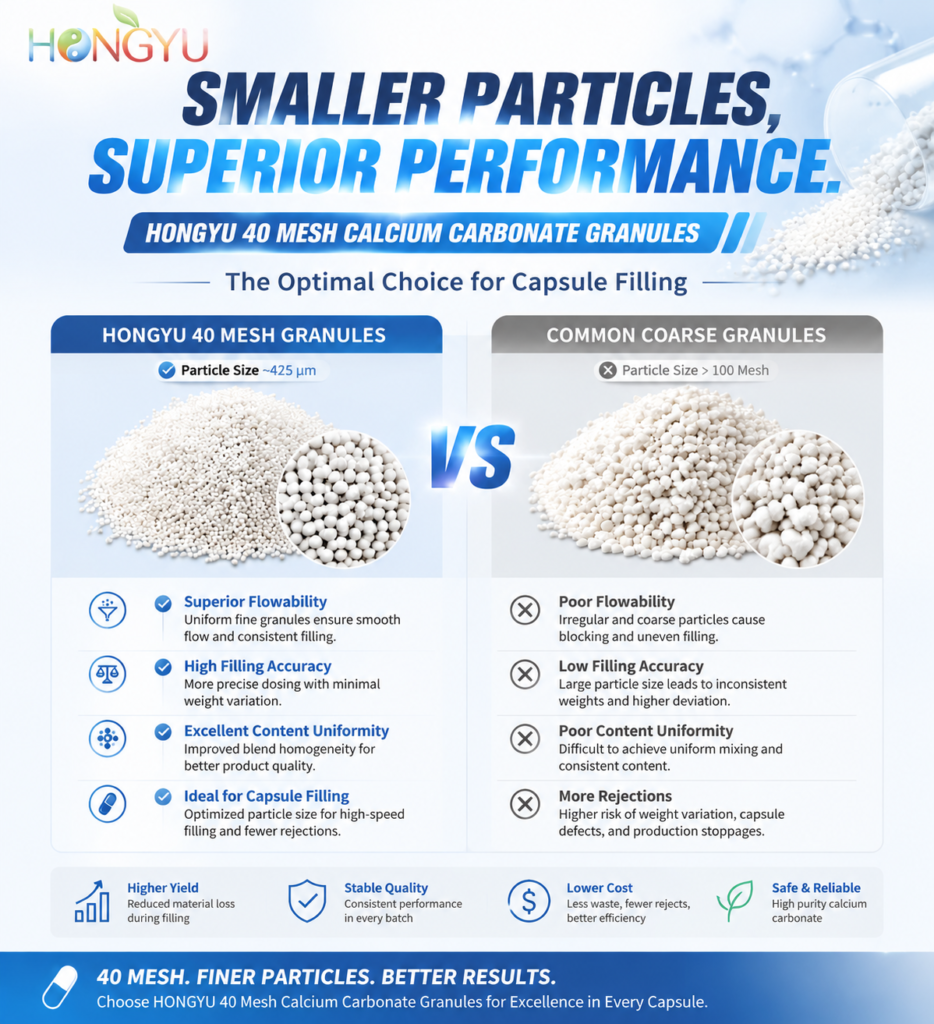
Engineering Superiority: 40-Mesh Granular Calcium Carbonate
Moving beyond chemical purity—optimizing the physical dynamics of powder systems for next-generation solid dosage manufacturing.
Critical Performance Comparison
| Physical Property | Standard USP Fine Powder | Hongyu Starry 40-Mesh Granules |
|---|---|---|
| Flow Dynamics (Angle of Repose) |
45° – 55° (Cohesive) Prone to “bridging” in hoppers. |
28° – 32° (Excellent)Ensures continuous gravity-fed flow at high speeds. |
| Compressibility (Hausner Ratio) |
> 1.40 (Very Poor) Requires high concentration of glidants. |
1.12 – 1.18 (Superior)Minimizes excipient load; ideal for direct compression. |
| Particle Morphology (SEM Observation) |
Irregular, sharp-edged fragments. High inter-particle friction. |
Spherical / Sub-rounded AgglomeratesReduces mechanical wear on high-speed punch tooling. |
| Bulk Density (Poured vs. Tapped) |
0.4 – 0.6 g/mL Inconsistent filling in small capsule sizes. |
0.95 – 1.15 g/mLIncreases dosage capacity by up to 40% per shell volume. |
| Dust Fraction (Fines < 100μm) |
Typically 60% – 80% Significant cross-contamination & safety risks. |
< 3%Maintains cGMP cleanliness; reduces filter replacement. |
Optimizing Your Production TCO
Filling Precision
- Eliminates Weight Variation (RSD < 2.0%).
- Guarantees Uniform Content of Active Ingredients (API).
- Supports high-speed encapsulation (up to 150,000 caps/hr).
Process Stability
- Reduced moisture sensitivity due to optimized surface area.
- Minimal segregation during long-duration mixing cycles.
- Prevents “capping” and “lamination” in tablet pressing.
Economic Yield
- Reduction in raw material waste by 15-20%.
- Extended lifespan of punch dies and dosing disks.
- Faster cleanup times between batches.
Technical Insight: The Balance of Porosity and Strength
Our 40-mesh granules are not merely crushed material. They are engineered via Fluid-Bed Spray Agglomeration. This creates a porous internal structure that facilitates instantaneous disintegration upon contact with gastric fluids, while maintaining the external hardness required to survive the mechanical stress of industrial blenders and transport systems.