
In the global nutraceutical and dietary supplement industry, few ingredients have witnessed a meteoric rise quite like magnesium glycinate powder. Once an obscure, niche compound known only to clinical nutritionists and functional medicine practitioners, it has evolved into a global blockbuster ingredient.
Driven by a post-pandemic surge in consumer self-care, the market for this premium mineral has exploded. Consumers are actively moving away from traditional, harsh sleep aids like synthetic melatonin and looking for holistic wellness options. By 2024, social media phenomenons like the viral “#SleepyGirlMocktail” and a widespread shift toward cleaner labels pushed magnesium glycinate into the absolute mainstream. Today, global brands—from legacy retail giants offering standard formulations like nature made magnesium glycinate to premium, direct-to-consumer labels—are scrambling to secure high-quality supplies.
However, this rapid market expansion has created a massive, underlying crisis for dietary supplement brands, contract manufacturers, and procurement officers: severe market dilution and compromised raw material quality. As hundreds of chemical brokers and trading companies rush to cash in on the unprecedented demand, the market has become flooded with sub-standard, poorly reacted, or outright faked materials.
For brands looking to launch or maintain a premium product line, understanding the strict science behind true mineral chelation—and partnering with a transparent, technically advanced manufacturer—is the only way to avoid consumer complaints, poor biological efficacy, and catastrophic legal liabilities.
🔍 Understanding the Chemistry: Magnesium Bisglycinate vs. Magnesium Glycinate
When sourcing raw materials from global suppliers, procurement officers and R&D teams frequently face confusion regarding nomenclature, specifically the comparison of magnesium bisglycinate vs magnesium glycinate.
In the commercial supplement marketplace, these two terms are often used interchangeably on consumer labels. However, from a strict chemical and molecular standpoint, bisglycinate magnesium is the technically precise scientific description. The prefix “bis-” derived from Greek, means “two.” This denotes that exactly one elemental magnesium ion (Mg²⁺) is chemically and stably bound to two separate molecules of the amino acid glycine via coordinate covalent bonds.
        [ Glycine Molecule ]
                \  (Coordinate Covalent Bond)
          [ Elemental Magnesium Ion ]
                /  (Coordinate Covalent Bond)
        [ Glycine Molecule ]
This specific molecular ring structure is what creates a “chelate” (derived from the Greek word for a crab’s claw, visualizing how the amino acids hold the mineral). This structure is critical because it protects the magnesium ion as it passes through the highly acidic environment of the human stomach.
Instead of breaking down prematurely and irritating the gastrointestinal tract—which is the primary cause of the laxative effect associated with cheap magnesium oxide or magnesium citrate—pure magnesium glycinate utilizes the body’s highly efficient dipeptide absorption pathways in the small intestine. This results in what the industry values as a highly bioavailable, high absorbing magnesium glycinate.
However, achieving this precise chemical ring structure requires sophisticated synthesis technology, exact temperature control, and premium-grade starting materials. This is where most standard market suppliers fail.
⚠️ Revealing the Industry Secrets: Dry Blends, False 14% Claims, and the Labeling Lawsuit Trap
Currently, almost every raw material factory and trading agent claims that their product is the “purest, fully reacted” material available. However、rigorous competitive analysis, third-party laboratory audits, and water-solution benchmarking reveal a widespread, troubling industry malpractice: The prevalence of fake chelates, known as “Dry Blends.”
Many manufacturers do not actually run a complete chemical reaction. Instead, they simply take cheap, unreacted magnesium oxide and mechanically blend it with crystalline glycine powder. They pack it into drums and sell it as “magnesium glycinate.” For unsuspecting buyers, this deception leads to massive technical and legal consequences at the finished product stage.
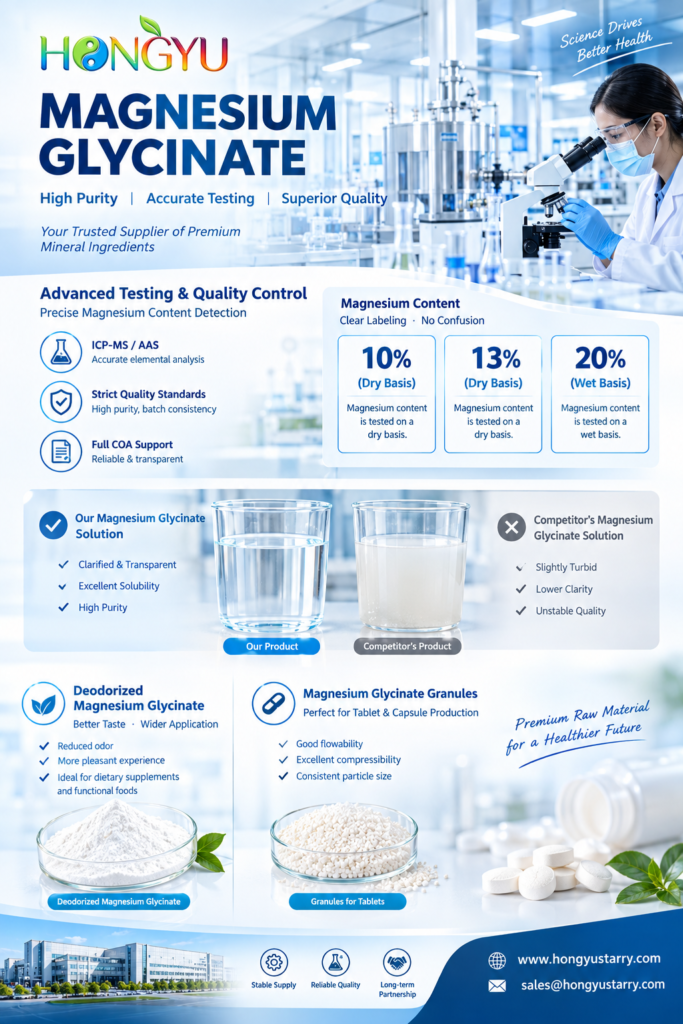
1. The Water Solubility and Clarity Test (The Ultimate Quality Indicator)
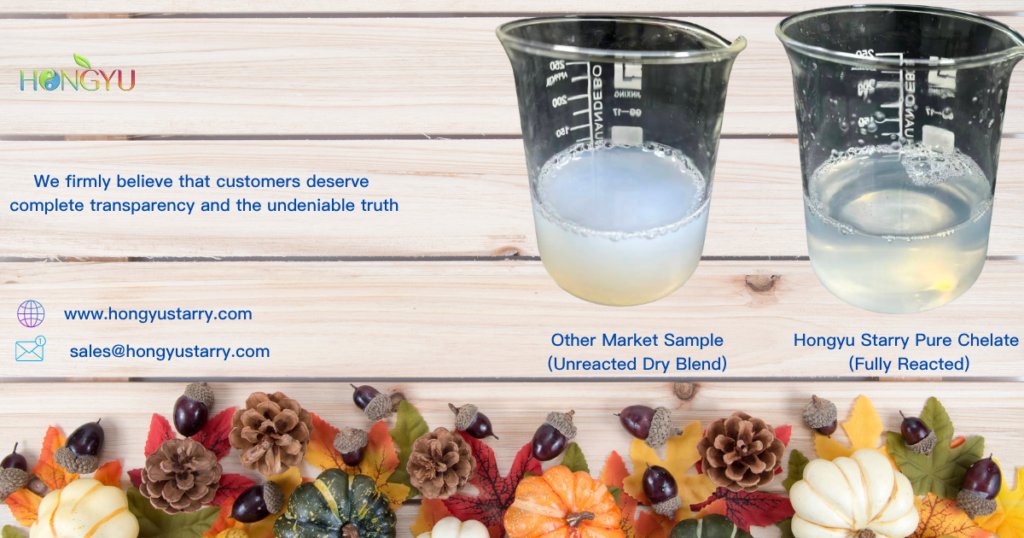
Unreacted magnesium oxide (MgO) is completely insoluble in water. When a procurement team tests a standard, low-grade market sample by dissolving it in water, the resulting solution is highly turbid, milky, and develops a heavy layer of chalky sediment at the bottom of the beaker.
In contrast, our fully reacted, pure magnesium glycinate exhibits exceptional water solubility. Because the chemical reaction is 100% complete, it dissolves quickly, yielding a crystal-clear, transparent solution without any precipitating unreacted particles. This makes our powder uniquely suited not just for standard solid doses, but also for clean-label premium ready-to-mix (RTM) powders, stick packs, and functional liquid beverages.
2. The Nightmare of Foul Odors
Naturally, unrefined or poorly synthesized magnesium glycinate carries a highly unpleasant, distinct odor reminiscent of strong ammonia or decaying fish. This foul smell easily penetrates standard gelatin or veggie capsules, leading to immediate consumer pushback and high return rates.
Through heavily invested R&D, our facility has successfully engineered an advanced deodorization production technology. We have eliminated these volatile organic odor compounds at the molecular level, delivering a truly odorless magnesium glycinate powder that enhances consumer compliance and flavor profiles.
3. The “14% Magnesium Content” Trap: A Legal Timebomb for Brands
In the B2B market, many buyers are constantly searching for the highest possible elemental magnesium yield. Capitalizing on this, several suppliers advertise a “14% elemental magnesium content” for their pure, unbuffered material.
Chemically, this is a mathematical and physical impossibility under real-world conditions.
Let’s look at the science: The absolute theoretical maximum of elemental magnesium in a completely 100% anhydrous (perfectly dry, zero-moisture) molecule of pure magnesium bisglycinate is approximately 14.1%. However, in commercial manufacturing, raw material powders naturally retain a small, safe percentage of ambient moisture. Therefore, on a real-world “As-Is” or wet basis, a genuinely pure, fully reacted chelate will strictly yield between 12.5% to 13.2% elemental magnesium.
+-----------------------------------------------------------------------------+

|                     ELEMENTAL MAGNESIUM CONTENT MATRIX                      |
+------------------------------------+----------------------------------------+

| Pure Anhydrous Chelate (100% Dry)  | ~14.1% (Theoretical Maximum Only)      |
+------------------------------------+----------------------------------------+

| Genuinely Pure Chelate (As-Is/Wet) | 12.5% - 13.2% (Industry Reality)        |
+------------------------------------+----------------------------------------+

| Advertised "Pure" 14% Market Raw   | Adulterated with unreacted Magnesium   |
| Material                           | Oxide to artificially boost numbers    |
+------------------------------------+----------------------------------------+
When a supplier guarantees a flat 14% or higher for “pure” material, they are almost always adulterating the batch with excess, unreacted magnesium oxide to artificially inflate the testing numbers.
When a dietary supplement brand purchases this dishonest material and manufactures finished capsules, they print their Supplement Facts labels based on the supplier’s faulty specifications. However, when regulatory bodies or aggressive third-party consumer advocacy groups (such as those conducting independent lab tests in the United States) pull these bottles off retail shelves, the truth comes out. The product fails the assay test because the magnesium isn’t actually bioavailable glycinate, but rather cheap oxide. This exact scenario has triggered a wave of multi-million dollar class-action lawsuits, brand revocations, and catastrophic damage to corporate reputations.
💎 Why Partner With Us? Total Transparency and Engineering Excellence
We believe that your raw material supplier should be your strongest shield against legal risk and product failure. We do not play numbers games with our specifications. Our high-precision testing laboratories utilize state-of-the-art HPLC, ICP-MS, and FTIR equipment to ensure absolute batch-to-batch consistency and total transparency.
- Sourced from China’s Highest-Purity Magnesium Oxide: Our synthesis process begins strictly with the highest-purity, low-heavy-metal pharmaceutical-grade magnesium oxide available in China. This ensures that our final chelate is exceptionally low in impurities like lead, arsenic, and cadmium, easily passing the strictest global prop-65 and EU regulations.
- Guaranteed Full Chelation: Our optimized liquid-phase chemical synthesis guarantees that every single magnesium ion is successfully locked into a glycine ring structure, ensuring optimal intestinal absorption and zero gastric distress.
- Transparent Dry Basis vs. Wet Basis Reporting: We eliminate the labeling guessing game. Every single Certificate of Analysis (COA) issued by our plant clearly and explicitly distinguishes between Dry Basis (Dry Base) and As-Is Basis (Wet Base) testing results. You will know exactly how much material to fill per capsule to meet your label claims perfectly, eliminating regulatory compliance worries.
- A Versatile, Tailored Product Portfolio:
To perfectly match your specific formulation needs, cost targets, and manufacturing equipment (whether you use high-speed encapsulation machines or tableting presses), we offer three distinct, clearly defined grades:- 10% Pure Magnesium Glycinate: Fully reacted, designed for specialized clinical formulations requiring exceptional powder flowability.
- 13% Pure Magnesium Glycinate: Our flagship product. The absolute gold standard of pure, fully reacted chelate, verified on a realistic moisture-inclusive basis.
- 20% Buffered Magnesium Glycinate: A highly cost-effective, premium-grade formulation. We explicitly state the precise ratio of added, high-purity magnesium oxide buffer. This allows you to legally, safely, and transparently hit higher elemental targets on your finished product labels without misleading your legal compliance teams.
☑ Secure Your Supply Chain with Absolute Confidence
In an era of high consumer demands, absolute ingredient transparency and verified efficacy are essential. Therefore, your choice of raw material dictates the future of your brand. Do not risk your hard-earned reputation on unreacted dry blends, fishy-smelling powders, or fraudulent 14% specifications.
Furthermore, our advanced manufacturing facility offers full regulatory documentation. We also provide comprehensive third-party lab verifications. Specifically, we offer complimentary pilot-scale validation samples for your R&D teams.
Please contact our global B2B procurement team today. You can easily request technical specifications, COAs, and customized quotes. Let us provide the pure science and unwavering transparency your brand deserves.