
🔬 Industry Insights: The “Chemical & Mathematical” Realities of Magnesium Glycinate Labels – How to Avoid Hidden Supply Chain Risks
In the dietary supplement supply chain, pure Magnesium Bisglycinate is highly sought after for its superior bioavailability and gastrointestinal tolerance. However, over my years of experience in this industry, I have witnessed many suppliers claim a 14% magnesium content, often supported by “dry basis” test reports.
As supply chain professionals, it is critical to look past the marketing numbers and analyze this through the lens of analytical chemistry, physical property limits, and global compliance trends.
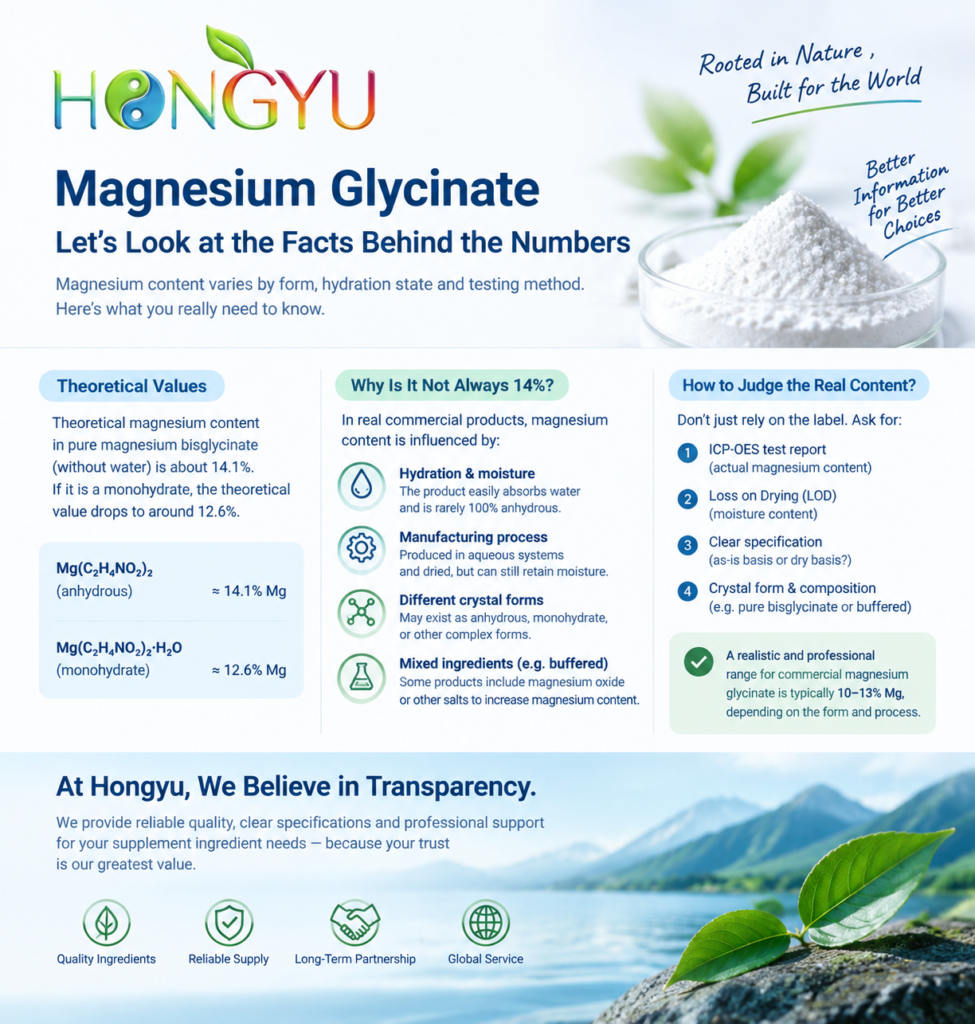
💡 1. Theoretical Maximums vs. Industrial Reality
Let’s break down the basic stoichiometry based on molecular weight:
- Pure Anhydrous Magnesium Glycinate [Mg(C₂H₄NO₂)₂]: The absolute theoretical maximum for elemental magnesium is 14.1%.
- Pure Magnesium Glycinate Monohydrate [The stable crystal structure]: Because it naturally holds a tightly bound lattice water molecule, its theoretical magnesium content is roughly 12.8%.
In large-scale commercial manufacturing (such as spray drying), the raw material naturally exists as a hybrid state—predominantly a monohydrate that has shed some of its moisture during processing. This is exactly why the United States Pharmacopeia (USP) brilliantly set the official monograph range for fully reacted pure magnesium glycinate at 12.0% – 14.0% .
If your Certificate of Analysis (COA) shows a dry basis magnesium content sitting between 12.6% and 13.5% (such as a solid 13.2%), you should celebrate . It means you have a highly authentic, fully reacted, and pure chelate without excessive free components or adulteration
⚠️ 2. Unmasking the 14%+ Traps in the Raw Material Market
In my opinion, when a supplier claims a 14% or higher magnesium content under the guise of an “anhydrous/dry basis” spec, such claims are a misleading tactic. They assume all moisture can be removed, which is practically impossible outside controlled lab environments due to the highly hygroscopic nature of the pure material.
In commercial reality, these 14%+ figures typically point to two underlying engineering realities:
- Intentional Over-Fortification: The supplier has intentionally added high-potency Magnesium Oxide (which contains 60% elemental magnesium) to artificially boost the overall magnesium levels on paper.
- Incomplete Chemical Reactions: The manufacturing process itself was flawed or rushed, leaving behind a significant amount of unreacted magnesium oxide or magnesium carbonate in the final powder.
While these shortcuts and dry-blending tricks make the COA figures look spectacular, they yield a “pseudo-chelate” that significantly drops the overall bioavailability and causes severe GI distress for the end consumer.
⚖️ 3. The Wave of Serious Legal Consequences
Ignoring these physical limits is no longer just a technical oversight; it has become a major legal liability. Western class-action attorneys have thoroughly mastered this “stoichiometric calculator trick.”
In recent years, several major brands and market leaders have faced serious legal consequences, regulatory scrutiny, and multi-million dollar class-action settlements. The root cause of these costly lawsuits is identical: brands labeled their products as 100% pure chelated magnesium glycinate, but their formulations relied on raw materials that had been bloated with unreacted or undeclared magnesium oxide.
When independent labs cross-referenced the capsule volume, density, and elemental weight, the math simply collapsed. It is physically impossible to pack over 3,000mg of pure glycinate powder (required to yield a standard high-dose of element Mg) into two standard capsules without relying on dense, heavy inorganic oxide fillers.
🤝 4. Our Responsibility to the End Consumer
Our ultimate responsibility as industry leaders is to provide honest information and ensure the absolute accuracy of our clients’ end products. The mature approach in supply chain management is to accept physical realities over marketing hype: - Formulate Honestly: Design your Supplement Facts panel using the realistic 12.5%–13.5% elemental range. If your supplier’s COA tests at around 13.0%, they are giving you an honest, high-quality, unadulterated pure batch .
- Be Transparent with “Buffered” Products: If you must use a buffered/blended material to keep capsule sizes small, explicitly state it in your ingredient list. Transparency does not hurt sales; it showcases your brand’s expertise and integrity.
Respecting chemical facts is your best compliance shield.
Have you ever encountered discrepancies between “Elemental Weight” and “Compound Weight” during your raw material audits? Let’s connect and discuss in the comments below!
💬 Join the Technical Discussion